Arenas and institutions: who gets a voice, information, protection, and an exit
People do not act on an empty field. Before they make a choice, roles, documents, time, language, decision rights, access to data, and the cost of refusal have already been distributed. This environment does not wholly determine conduct, but it makes some actions easy, others costly, and still others almost invisible.
An arena sets the conditions for a particular form of participation, while an institution reproduces those conditions over time. Real freedom must therefore be sought not only in the text of a rule, but also in its enforcement, avenues of appeal, and an affordable exit.
If we look only at personal character, systematic advantage appears to be merit, compelled agreement appears to be free choice, and recurring harm appears to be a series of accidental errors.
First, distinguish
Two concepts that are easy to mistake for one another
A formal rule is a written requirement, right, or prohibition. A rule in practice is the stable expectation that a given action will lead to a given consequence. A code may permit employees to report misconduct, but if those who report are isolated and never promoted, the operative rule is: ‘Keep quiet if you want to stay.’
An arena is a bounded domain where interactions recur with shared stakes, resources, and judges. An institution is the durable set of rules, roles, and procedures that reproduces or changes that domain over time. A particular competition for a position takes place in the arena of selection; document requirements, the committee’s authority, and the appeals process belong to the institution of hiring.
Map an arena through six groups of questions
Before judging conduct, ask: who participates and bears the consequences; which actions are genuinely available; who possesses what and who knows what; who sets, enforces, and judges the rule; how history and metrics direct behavior; and who can object, appeal, or leave.
Why this happens
Each group of questions reveals a different constraint. Resources make refusal possible; information makes a problem provable; a judge turns a claim into a decision; history creates the familiar cost of deviation; and voice and exit limit the rule’s power. Omit one layer and compelled behavior can easily become a story about character.
When an employee is considered for promotion, comparing résumés is not enough. We must see who received visible assignments, who knew the criteria in advance, whose mistakes were treated as learning, who selects the judges, and where a person can turn after a breach of procedure.
Do not confuse this with
A map of an arena describes the conditions of participation. It does not predict conduct or turn the institution into the sole cause of behavior.
Where the idea stops working
The six groups are an editorial aid for remembering what matters, not a complete theory of society. The analyst draws the boundary and must name the affected people and consequences left outside it.
Question for the situationWhich layer of this arena most changes a person’s ability to refuse, object, or offer an alternative?
The text of a rule does not work without enforcement and appeal
A rule becomes operative when participants know who establishes that a violation occurred, who can enforce the decision, and where an error or an abuse by the judge can be corrected.
Why this happens
Predictable enforcement connects an action to its consequence. Appeal limits the enforcer’s power, while the participation of affected people in revising the rule sustains its legitimacy. Without these links, a right remains a promise and sanctions depend on proximity to power.
A company prohibits retaliation against employees who report a defect, but complaints are reviewed by the accused manager’s superior, no deadlines exist, and decisions are not published. After the first quiet reprisal, the rule in practice becomes the opposite of the official one.
Do not confuse this with
Legality asks whether a decision follows an established procedure. Legitimacy asks whether people recognize that procedure’s right to govern them. Justice asks whether the arrangement itself withstands moral criticism. These tests can diverge.
Where the idea stops working
A popular rule can be unjust, while an unpopular one can protect the weak. Not every exception is arbitrary, but under unequal power its basis must be explainable and open to verification.
Question for the situationWho scrutinizes the enforcer of the rule, and what safe path remains for a person after an erroneous decision?
An institution repeats both a discovered solution and an old mistake
Institutions preserve past choices through roles, categories, documents, and habitual routes. Useful coordination and unjust exclusion can therefore continue after the people involved have changed.
Why this happens
A standard reduces uncertainty and makes coordinated action at scale possible. Skills, jobs, interests, and technical systems then grow around it, raising the cost of change. A category makes part of reality visible to the center, but erases what does not fit inside it.
A company has required paper signatures for decades. The paper is no longer needed for reliability, but authority, audits, and jobs have been organized around it. Replacing the form touches the entire chain of responsibility, so the obsolete rule outlives its authors.
Do not confuse this with
Institutional inertia does not necessarily imply a conspiracy. An order can reproduce itself because each person locally follows an intelligible route even when no one considers the overall result reasonable anymore.
Where the idea stops working
History constrains but does not predetermine. Standards also create rights, compatibility, and protection from personal whim; criticizing simplification is not a call to abandon common forms.
Question for the situationWhat former problem does the current rule solve, does that problem still exist, and what new cost does the rule now create?
Synthesis without reconciliation at any price
A just institution must be both general and able to see the exception
A general rule protects people from personal whim, stores experience, and lets strangers coordinate. But it remains just only when enforcement can be scrutinized, appeal is accessible, people with different starting positions can participate in practice, and local knowledge can correct a category that is too crude.
A tension worth preservingThe more uniform a rule, the easier it is to scale and control; the more attentive it is to a particular case, the greater the risk of inconsistency and privilege. The task is not to choose one pole, but to create transparent exceptions and scrutiny of who receives them.
Long view
An essay that carries this idea through a complete argument

Why a dispute about power begins before a command or a vote—with the authority to name the problem, build the category, and decide whose bad news will be heard.
The World Is Made of More Than Games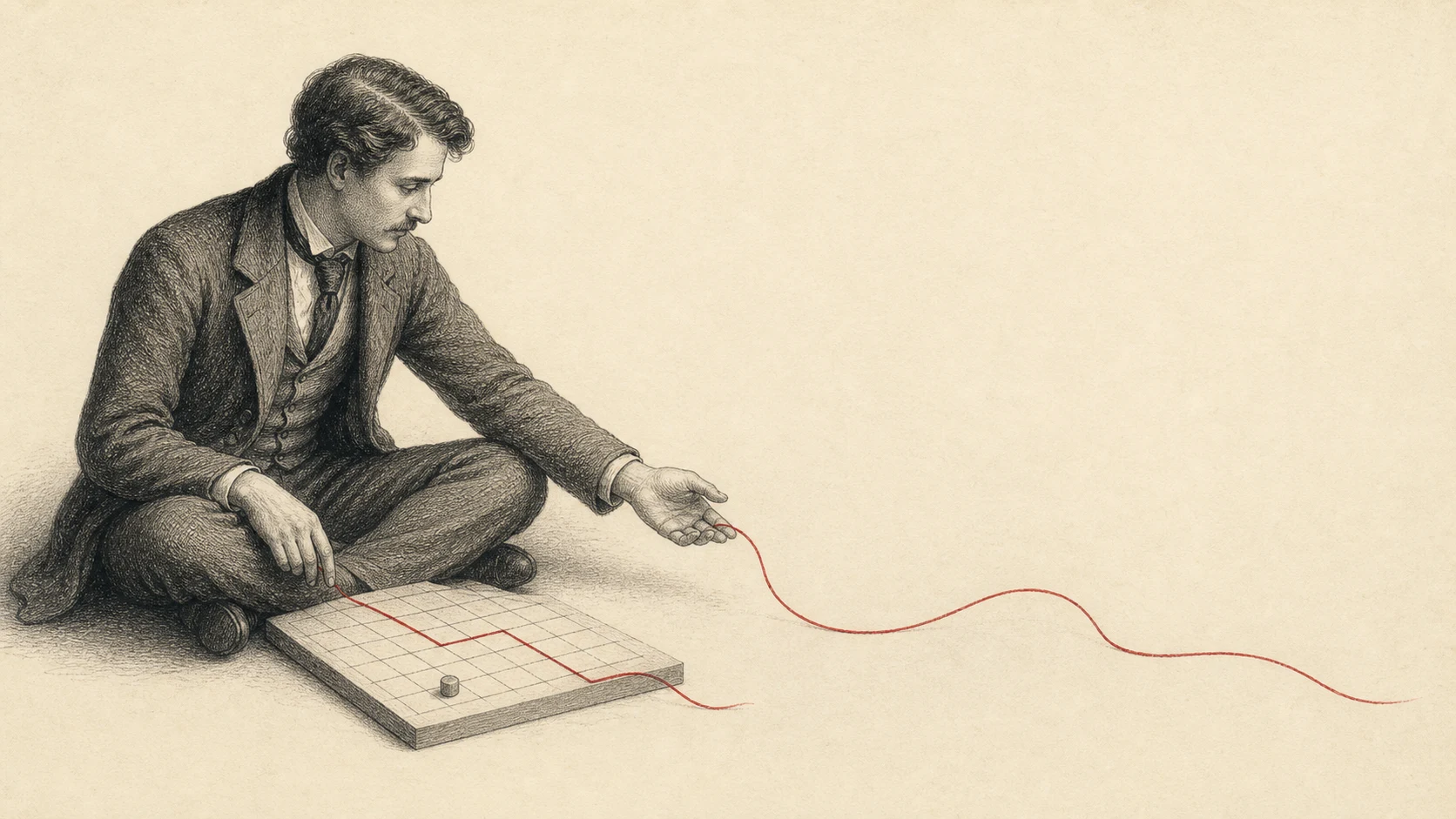
The language of games is useful when it reveals mutual expectations, hidden options, and responsive actions. It becomes dangerous when it quietly turns every relationship into a calculation, every person into a player, and love, care, coercion, grief, and mortality into matches that could supposedly be played correctly.
Strategy Is the Art of Organized Refusal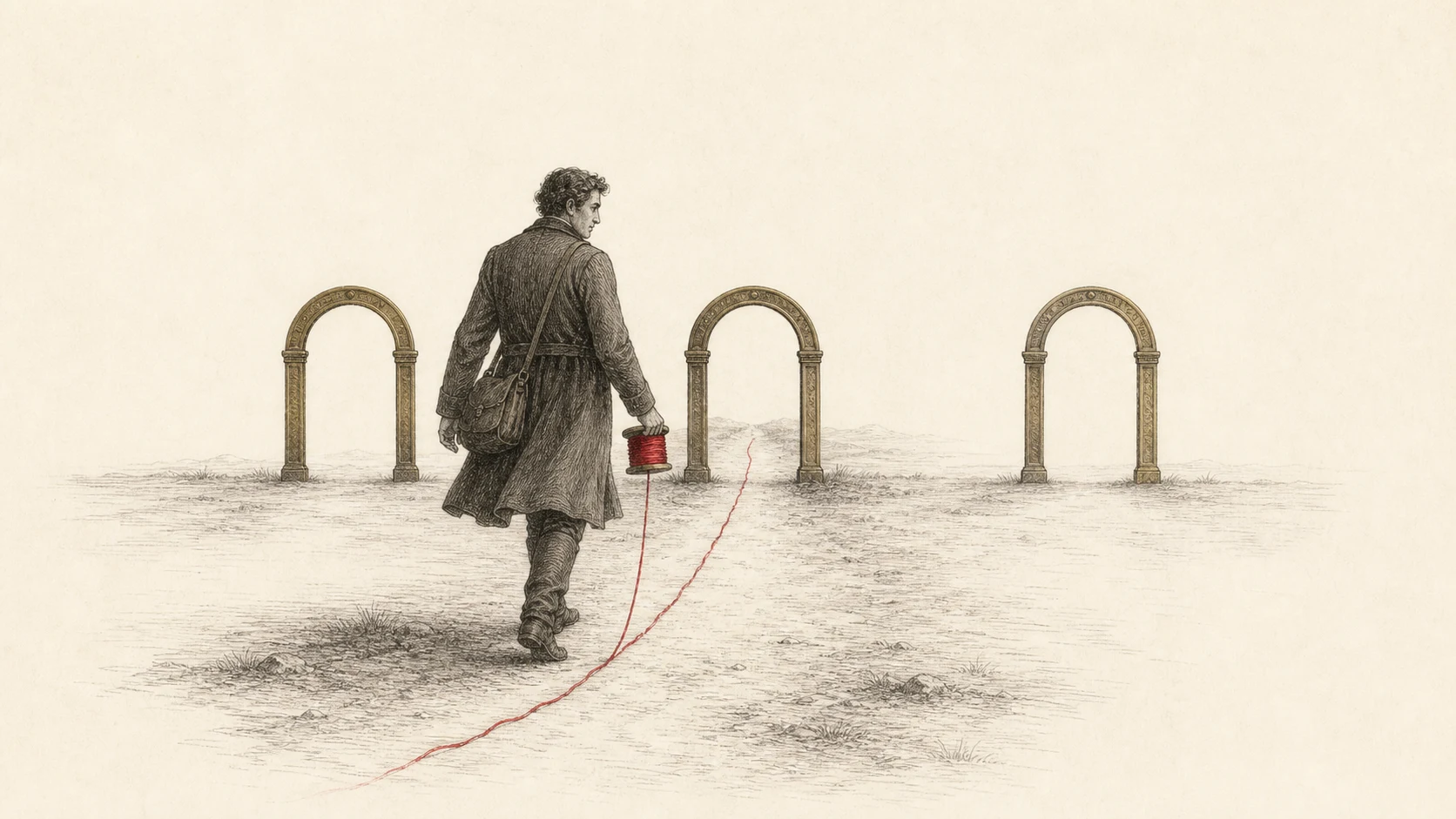
Strategy begins where not every good thing can be done at once. It turns a diagnosis of the central difficulty into a coherent set of actions and makes the price of choice visible: which possibilities will be postponed, which obligations will remain, and which boundary must not be crossed even for the desired result.
Continue the thought
Works that test the thesis rather than repeat it
To govern a complex world, a central authority makes it legible—and may destroy local knowledge that does not fit the scheme.
The Presentation of Self in Everyday LifeErving GoffmanPeople jointly sustain definitions of situations and social roles; sincerity does not eliminate the stage, expectations, or impression management.
Governing the CommonsElinor OstromCommunities can preserve a common resource when rules fit the place, participation is real, and monitoring and sanctions are recognized by the participants.
The shoulders this chapter stands on
A source is not a seal of truth. Each entry says what it clarifies and where its lens needs to be limited.
Pierre Bourdieu
The Forms of Capital; the theory of fields and habitus
What it clarifies
A resource has force within a field: money, connections, education, manner of speech, and recognition operate by different rules and cannot be converted into one another without cost.
What it does not prove
The language of reproduction can underestimate unexpected action, creativity, and genuine changes in the rules.
James C. Scott
Seeing Like a State
What it clarifies
To govern many people, a center simplifies reality into categories and measures; together with noise, it may erase the knowledge on which life depends.
What it does not prove
Criticism of simplification does not imply that coordination at scale, measurement, and standards are always harmful.
Elinor Ostrom
Governing the Commons
What it clarifies
Between privatization and command from above lie many durable arrangements that users of a common resource create and monitor themselves.
What it does not prove
Self-governance does not work automatically: boundaries, trust, observability, the right to change rules, and proportionate sanctions all matter.
Amartya Sen
Development as Freedom and the capability approach
What it clarifies
Freedom is not only a formal right or a resource, but the real opportunity to be and do what a person has reason to value.
What it does not prove
The approach deliberately provides no single list of goods; evaluating capabilities in practice remains contested and contextual.
Hannah Arendt
On Violence
What it clarifies
Power is not a leader's possession: it exists for as long as people remain capable of acting in concert.
What it does not prove
Real regimes often mix consent, dependence, coercion, and violence; a clean distinction does not describe the entire mixture.
Albert O. Hirschman
Exit, Voice, and Loyalty
What it clarifies
When a system deteriorates, a person can leave, try to change it through voice, or remain out of loyalty; the availability of each response changes the others.
What it does not prove
Real people may be trapped without safe exit or voice; loyalty can be either constructive or exploited.
Donella H. Meadows
Thinking in Systems; Leverage Points
What it clarifies
A recurring result is often produced by stocks, flows, feedback loops, delays, information, and rules rather than by one culpable event.
What it does not prove
A systems diagram is a selected map; it can conceal conflicting interests, human meaning, and the people who defined the model's boundary.