How to build an organization where error becomes knowledge rather than a career sentence
Smart employees do not by themselves create a learning organization. If bad news endangers the messenger, has no destination, or changes no decision, the system loses its senses. People can then work honestly inside rules that reproduce the same failure.
An organization’s capacity to correct itself is a connected chain: notice a deviation, transmit the signal safely, investigate the cause at the right level, change an action or rule, and test the consequences. Break any link and “learning from mistakes” becomes a ritual.
Without protected truth, small deviations accumulate into disaster. But safety without standards and follow-through becomes endless discussion in which no one is accountable. What is needed is a system that both admits an unwelcome signal and demands a verifiable correction.
First, distinguish
Two concepts that are easy to mistake for one another
Causal analysis asks which actions, rules, incentives, and connections produced the event and made it repeatable. An assessment of blame asks who breached a duty despite available alternatives. The questions can meet, but a quick search for a culprit often hides the mechanism, while talk of “the system” must not erase intent or gross negligence.
In the first case, the organization restores the result to an established standard. In the second, it asks whether the goal, metric, allocation of authority, or initial assumption is producing the problem. Fine-tuning execution is not enough when the frame is wrong.
Bad news needs a route that does not require heroism
An unwelcome message becomes an effective signal when it has a clear destination, protection from retaliation, the attention of someone with authority, and visible follow-through.
Why this happens
Hierarchy ties dissent to career risk. Each intermediary softens the signal a little to avoid looking difficult, and a red risk turns green without any direct order to lie. A protected channel lowers the personal cost of truth; a required response shows that reporting it has a point.
An engineer flags a critical defect. The team lead calls it “under control,” a director calls it “a technical detail,” and the board sees a green status. A direct route to the risk committee and a rule requiring a written response preserve the original signal and responsibility for the decision.
Do not confuse this with
Do not confuse psychological safety with guaranteed agreement: an employee has the right to report and be heard, but the conclusion is still tested against facts and standards.
Where the idea stops working
Leaders need signal triage or the important will drown in the raw stream. A truth channel needs urgency criteria, confidentiality safeguards, and accountability for knowingly false reports.
Question for the situationWhere does bad news go here, what does the messenger risk losing, and what mandatory action follows the signal?
An error tests not only the person, but the system of detection and protection
After a serious failure, examine not only the last wrong action but also why the system allowed it, failed to detect it earlier, and did not contain the consequences.
Why this happens
A repeatable outcome emerges from several layers: training, interface, workload, incentives, allocation of authority, and protective barriers. Replace one person while leaving these relationships intact, and the next error will find another route to the same outcome.
A nurse administers the wrong dose. Dismissal will not fix look-alike drug names, tiny print, two consecutive night shifts, and the lack of an independent check. The review must see both the individual action and the conditions that made it likely and dangerous.
Do not confuse this with
Do not confuse a systemic explanation with collective innocence: causes may be many, while the professional or moral responsibility of a particular person may still exist.
Where the idea stops working
Systems language must not conceal intent, falsification, or conscious disregard of a known risk. These require separate procedures of assessment and protection for those harmed.
Question for the situationHow could the next person in the same position repeat this failure, and what barrier would stop the error before it causes harm?
Organizational learning ends with change and verification
A review becomes organizational learning when its conclusion changes an action, rule, or assumption, and subsequent observation shows whether the recurring risk has decreased.
Why this happens
A clear hypothesis connects a change to an expected effect. In reversible and safe conditions, it can be tested in a small experiment. Where an experiment could cause severe irreversible harm, it is replaced or supplemented by simulation, historical comparison, independent review, redundancy, and the precautionary principle.
An online store can test a new checkout form on part of its traffic and roll it back quickly. A nuclear plant must not test the limit of its safeguards through a real accident; it needs modeling, independent audit, and several physical barriers.
Do not confuse this with
Do not confuse the speed of feedback with its reliability or acceptability. A fast test is useful only when it measures the right effect and does not shift unacceptable risk onto others.
Where the idea stops working
Data will not resolve every question of value or politics: parties may agree about consequences but disagree over who receives the benefit, who bears the risk, and who has the right to decide.
Question for the situationWhat exactly changed after the review, by what sign will we test the effect, and who bears the cost of our test?
Synthesis without reconciliation at any price
Correctability is a property of design, not good intentions
An organization learns when doubt is built into roles, channels, and decisions: a signal can be transmitted, the frame can be reconsidered, and a change can be tested. This is not a cult of error. Error remains a loss, but hiding it ceases to be a condition of belonging, and correction no longer depends on a rare brave person.
A tension worth preservingProtecting dissent without requiring evidence produces noise. Requiring evidence without protecting dissent produces convenient silence. A self-correcting organization holds both conditions at once.
Long view
An essay that carries this idea through a complete argument

How can we remain faithful to reality when we encounter it only through imperfect observations, instruments, words, and institutions of knowledge?
Who Has the Right to Define Reality?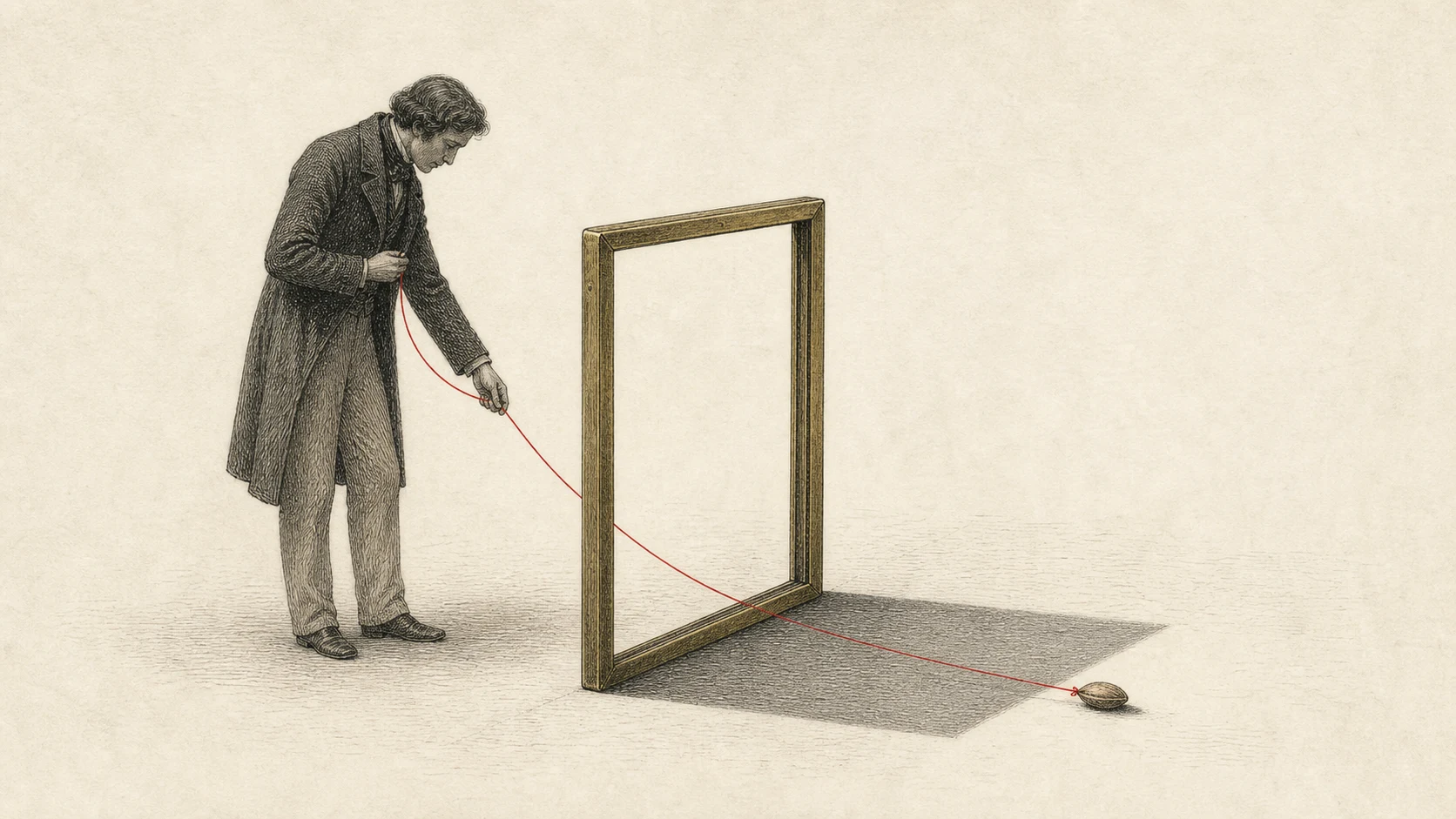
Why a dispute about power begins before a command or a vote—with the authority to name the problem, build the category, and decide whose bad news will be heard.
Continue the thought
Works that test the thesis rather than repeat it
Recurring events are produced by a system’s stocks, flows, feedback loops, delays, rules, and goals.
The Reflective PractitionerDonald SchönA professional learns within action when the situation’s response forces a reconsideration of how the problem itself was framed.
12 Angry MenSidney LumetDoubt becomes a public force when a person does not claim to be infallible, but asks the group to examine the traces and conclusions again.
The shoulders this chapter stands on
A source is not a seal of truth. Each entry says what it clarifies and where its lens needs to be limited.
Chris Argyris
Double Loop Learning in Organizations
What it clarifies
Sometimes what must be corrected is not an action within a rule, but the rule, goal, or assumption that governed the action.
What it does not prove
A call to revise the frame can become endless reflection and avoidance of necessary practice.
Amy C. Edmondson
Psychological Safety and Learning Behavior in Work Teams
What it clarifies
A team learns when reporting an error, asking a question, and disagreeing do not create unacceptable interpersonal risk.
What it does not prove
Psychological safety does not mean an absence of standards, conflict, responsibility, or uncomfortable feedback.
Richard Feynman
Cargo Cult Science
What it clarifies
The first requirement of inquiry is to actively report evidence that could show one's own explanation to be wrong.
What it does not prove
Personal honesty is necessary but insufficient without sound methods, independent scrutiny, and institutions that protect criticism.
Herbert A. Simon
Administrative Behavior
What it clarifies
People choose with limited time, attention, and knowledge, so they seek an option that is good enough rather than calculate a global maximum.
What it does not prove
Boundedness does not release us from improving decisions; it requires us to design the environment, search rules, and feedback.
W. Edwards Deming
The New Economics and the System of Profound Knowledge
What it clarifies
A manager must distinguish random variation from a persistent cause and repair the system rather than turn every deviation into a trial of the individual.
What it does not prove
Not all responsibility dissolves into the system; people retain professional and moral duties.
Donella H. Meadows
Thinking in Systems; Leverage Points
What it clarifies
A recurring result is often produced by stocks, flows, feedback loops, delays, information, and rules rather than by one culpable event.
What it does not prove
A systems diagram is a selected map; it can conceal conflicting interests, human meaning, and the people who defined the model's boundary.
Max Weber
Politics as a Vocation
What it clarifies
A responsible actor considers not only the purity of conviction, but also the foreseeable consequences of using force.
What it does not prove
Appeals to consequences easily become excuses for an absence of principle when no limits are stated in advance.
Karl Popper
Conjectures and Refutations
What it clarifies
Knowledge grows not from infallibility, but from an arrangement that allows a strong hypothesis to encounter the possibility of error.
What it does not prove
Scientific practice is more complex than a single act of refutation; evidence depends on measurement, auxiliary assumptions, and a community.