A decision is made with the available evidence; the outcome arrives later
Before a choice, several futures are possible; after it, only one outcome has occurred. Knowing the result easily creates the illusion that it was obvious all along. To truly learn, we must assess separately the quality of the reasoning before the outcome and the information brought by the outcome.
A sound decision does not guarantee victory. It improves the odds of an acceptable result, limits intolerable harm, and leaves a clear record for later learning.
When we judge only by outcomes, lucky recklessness passes for skill and a justified risk for stupidity. We reward bad processes, hide the role of chance, and repeat bets that may leave no next attempt.
First, distinguish
Two concepts that are easy to mistake for one another
A decision is a choice made from the information, options, and constraints available before action. An outcome is what happened afterward under the combined influence of the choice, other people's behavior, and chance. The outcome matters as a real effect and as new information, but it cannot retroactively give the decision-maker knowledge that did not then exist.
Risk is a situation in which the important outcomes are known well enough to estimate, at least roughly, their probabilities and costs. Under uncertainty, the options, probabilities, or mechanism itself may be incompletely described. Risk can be calculated and insured; under deep uncertainty, small reversible steps, diverse sources, and a margin for the unknown matter more. The boundary between the two depends on the quality of knowledge, not the speaker's confidence.
A good choice can end badly, and a bad one can get lucky
The quality of a decision and the quality of its outcome should first be judged separately and then connected: the former by the evidence and process available before action, the latter by the actual effect and the lesson it brings.
Why this happens
Chance and other people's actions produce a range of outcomes even after the same choice. Once the result is known, memory turns prior uncertainty into a smooth story; without reasons recorded in advance, we cannot honestly distinguish a flawed process from bad luck.
Following accepted medical standards, a doctor chose an operation with a 90 percent chance of success, but the patient died. The tragedy demands investigation and care for those harmed, yet the outcome alone does not prove the decision was negligent.
Do not confuse this with
Do not confuse defending a sound process with exemption from consequences. Even without fault, duties remain: to help, test the model, and change the practice if a series of outcomes reveals a systemic error.
Where the idea stops working
An appeal to chance fails when risks were concealed, evidence ignored, or failures recur more often than the model allowed.
Question for the situationWhat was known at the moment of choice, which alternatives were considered, and what does the outcome teach us now that we could not have known then?
Probability becomes useful when it is recorded, tested, and updated
A numerical probability does not remove uncertainty, but it makes confidence explicit and lets us test whether that confidence matches the frequency of success.
Why this happens
People understand words such as “possibly” and “almost certainly” differently. A number, a deadline, and an observable outcome create a common criterion; a series of forecasts reveals where someone is systematically overconfident. The base rate of similar cases prevents one vivid story from capturing the whole judgment.
Instead of saying “the supplier will definitely miss the deadline,” a manager records: “There is a 60 percent chance of delay; it falls to 30 percent if a working prototype arrives by Friday.” On Friday, the team updates its estimate from the signal, not its mood.
Do not confuse this with
Do not confuse a precise probability statement with precise knowledge of the world. A number can be a disciplined estimate—or decoration on a poor model.
Where the idea stops working
Past frequencies may fail during rare breaks. Nor can a singular moral decision be derived from probability alone: expected effect does not decide what cost may rightfully be imposed on another person.
Question for the situationWhat is the base rate for comparable cases, what would change my estimate, and when will the forecast become testable?
First ask whether you will retain the right to try again
Under high uncertainty, a wise first bet gains information without exposing health, trust, capital, or freedom of action to intolerable risk.
Why this happens
A reversible step turns part of the unknown into an observation while preserving the option to change course. Irreversible harm ends learning: even a high average return is useless to a person or system whom one bad outcome deprives of future action.
Instead of a year-long rollout of an untested system, a company pilots it in one division, defines stop conditions in advance, and keeps the old process as a temporary fallback.
Do not confuse this with
Do not confuse caution with inaction. Sometimes delay is itself irreversible: the window for treatment, evacuation, or protecting a person closes.
Where the idea stops working
Other people cannot be turned into a testing ground merely because an experiment is convenient for management. A small step still requires consent, safeguards, and limits on harm.
Question for the situationWhat smaller step would provide decisive information, what harm cannot be repaired, and what will be lost if we wait?
Synthesis without reconciliation at any price
Do not predict one outcome; manage the quality of the bet
Simon reminds us that decisions are made by limited people in limited time. Kahneman and Tversky reveal persistent errors in such judgment; Gigerenzer adds that a simple rule may be rational when it fits the structure of the environment. Tetlock contributes a practical discipline: record probabilities and update them. The shared conclusion is not that everything must be calculated, but that confidence needs a form, a bet needs a limit on harm, and an outcome must retain the right to correct the model.
A tension worth preservingA fast heuristic saves time in a familiar environment, but becomes dangerous when the environment has changed, feedback is delayed, or an error would be irreversible.
Long view
An essay that carries this idea through a complete argument
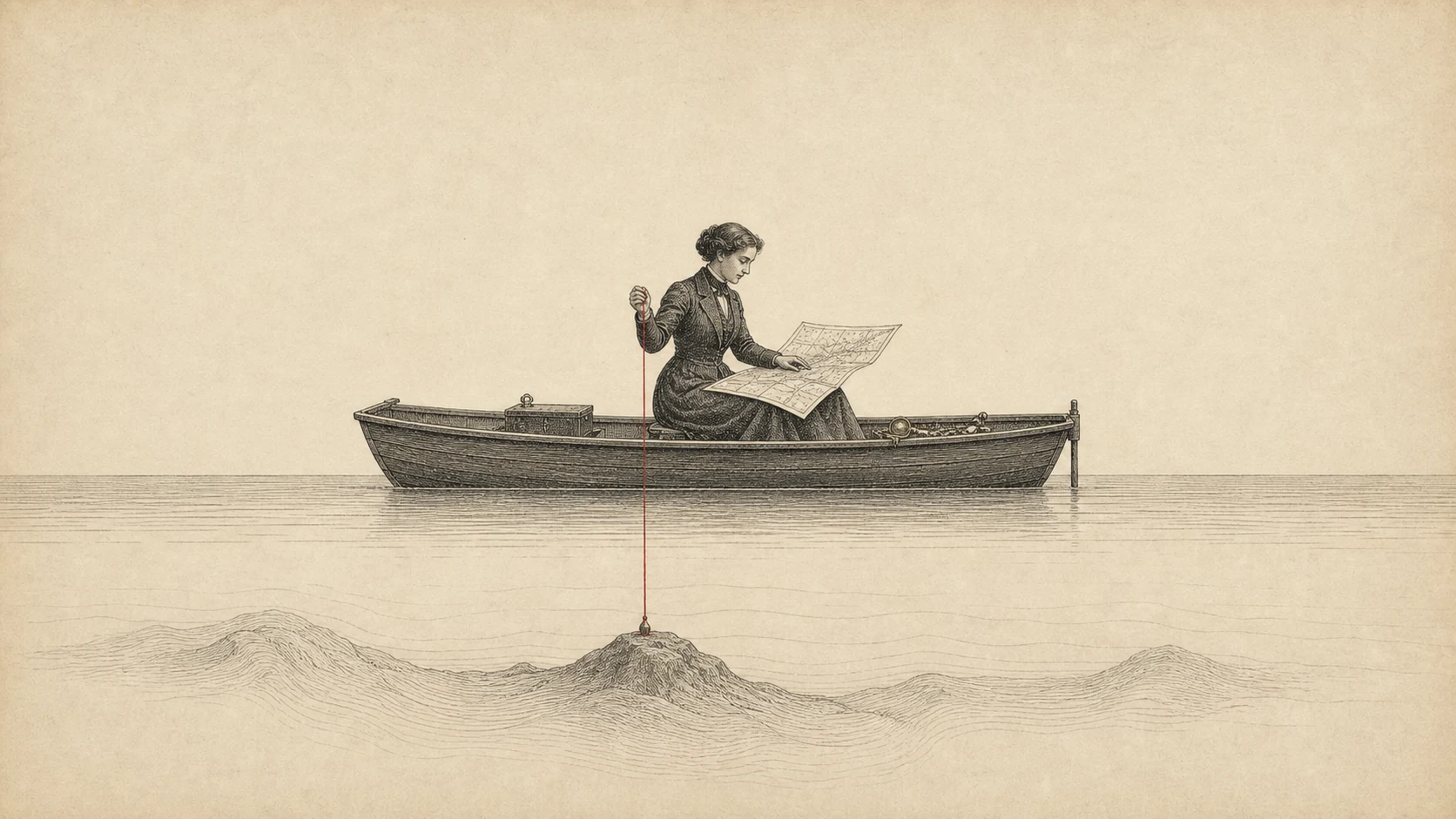
How can we remain faithful to reality when we encounter it only through imperfect observations, instruments, words, and institutions of knowledge?
Victory changes the winner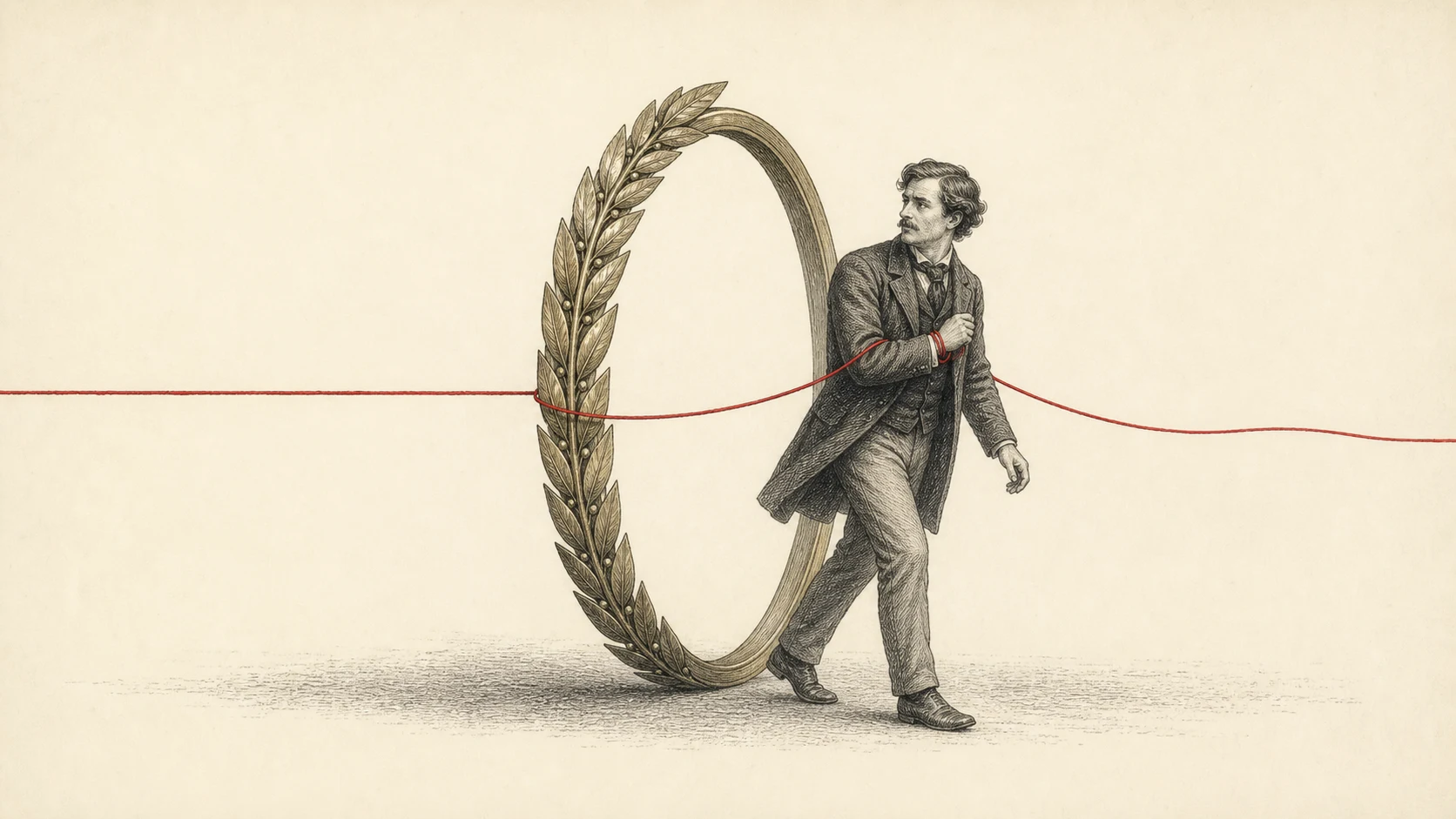
Success does more than give a person greater possibilities. It changes the people around them, the information that reaches them, and the explanation they construct about themselves. The central danger of victory therefore begins not when the result is lost, but when the result is taken as final proof that the winner was right.
Continue the thought
Works that test the thesis rather than repeat it
An experienced person often does not compare dozens of options; they recognize the situation, test the first workable course, and notice anomalies.
SuperforecastingPhilip Tetlock and Dan GardnerForecasts improve when they are expressed as probabilities, broken into parts, updated with evidence, and scored for error.
Moral LuckBernard WilliamsWe judge people by consequences that did not depend on them alone; life does not let us separate responsibility completely from chance.
The shoulders this chapter stands on
A source is not a seal of truth. Each entry says what it clarifies and where its lens needs to be limited.
Daniel Kahneman and Amos Tversky
Research on judgment and decision-making under uncertainty
What it clarifies
Predictable features of attention and framing systematically change judgments of probability, loss, and gain.
What it does not prove
A catalogue of biases does not make people hopelessly irrational and cannot replace analysis of the environments in which a simple heuristic may work well.
Philip Tetlock, Barbara Mellers, Nick Rohrbaugh, and Eva Chen
Forecasting Tournaments
What it clarifies
Forecasting tournaments make probabilistic judgments comparable and show how training, teamwork, and aggregation can improve their accuracy.
What it does not prove
Not every important question has a clear deadline and testable outcome; a good forecast still does not choose a worthy goal.
Bernard Williams and Thomas Nagel
Essays on Moral Luck
What it clarifies
Our moral judgments depend on consequences and circumstances that a person controls only in part.
What it does not prove
Recognizing luck does not abolish responsibility; it makes our assessment of responsibility more accurate and modest.
Gerd Gigerenzer
Ecological Rationality and Simple Heuristics
What it clarifies
A rule's quality cannot be judged apart from its environment: a bounded heuristic may outperform a complex model when it exploits a stable structure in the world.
What it does not prove
Simplicity is not a virtue in itself; alternatives must be compared and the conditions for success made explicit.
Herbert A. Simon
Administrative Behavior
What it clarifies
People choose with limited time, attention, and knowledge, so they seek an option that is good enough rather than calculate a global maximum.
What it does not prove
Boundedness does not release us from improving decisions; it requires us to design the environment, search rules, and feedback.
Nassim Nicholas Taleb
Fooled by Randomness
What it clarifies
A visible winner does not prove the quality of the process: we must look for the role of luck, invisible losers, and risks capable of eliminating the next attempt.
What it does not prove
Taleb's own polemical style and vivid stories also require examination, not submission to a new authority.
Karl Popper
Conjectures and Refutations
What it clarifies
Knowledge grows not from infallibility, but from an arrangement that allows a strong hypothesis to encounter the possibility of error.
What it does not prove
Scientific practice is more complex than a single act of refutation; evidence depends on measurement, auxiliary assumptions, and a community.