Why power receives an edited reality—and how to restore its feedback
Power expands the capacity to act, but it also changes the flow of information to the person who holds it. People object more cautiously, intermediaries smooth away risk, and the experience of those affected becomes an average number. A powerful person can therefore possess more data and see the cost of their own decision less clearly.
Five filters create the blind spots of power: cognitive limits, protection of identity, a dependent circle, institutional interest, and changes of scale. Personal humility helps, but it is not enough. Access to reality is preserved by procedures of self-restraint: independent review, protected dissent, the direct voice of those affected, reversible decisions, and clear transfer of power.
Power is needed to coordinate and to assume responsibility for action; strength itself is not a vice. The danger begins when the capacity to decide grows faster than the capacity to hear the consequences. Sincere confidence then becomes a mechanism of large-scale harm.
First, distinguish
Two concepts that are easy to mistake for one another
When access, safety, or trust have always been present, a person experiences them not as advantages but as the normal world. They may mistake the result of supportive infrastructure for pure proof of talent without denying the reality of their own effort and ability.
A devoted aide may shield a leader from unwelcome information. A reliable channel is designed so that a critical fact gets through regardless of affection, status, or the preferred conclusion.
Intelligence can strengthen both scrutiny and self-justification
Sophisticated reasoning gives a person more ways both to test a belief and to explain why an inconvenient fact supposedly does not apply to their case.
Why this happens
The desired conclusion protects status, a project, or a self-image. Reason searches for exceptions for one’s own results, demands stronger evidence from critics, and turns each failure into a special case. The capacity to build a complex argument conceals an unequal standard of proof.
When sales of their own product are poor, a founder points to seasonality, the early stage, and a flawed sample. Faced with the same numbers for someone else’s project, the founder demands immediate closure. The problem lies not in one explanation but in applying different rules to oneself and others.
Do not confuse this with
Do not confuse possible rationalization with proven deception: an opponent’s disagreement may rest on data you have not considered.
Where the idea stops working
Motivated reasoning is a tendency, not a diagnosis based on one dispute. Test the symmetry of the criteria, predictions made before the outcome, and a willingness to name the fact that would change the conclusion.
Question for the situationWhat standard would I apply to the same data if the conclusion threatened someone else’s project rather than my own?
A familiar advantage feels like the normal structure of the world
When access, safety, and support have long been available to someone, they tend to underestimate their causal role and explain the result mainly through personal qualities.
Why this happens
A constant support ceases to feel like a separate condition, and the person has never lived the counterfactual path without it. After success, one’s own effort is visible; a family guarantee, early access, trust through connections, and people whose similar efforts were stopped by a missing condition are harder to see.
An entrepreneur genuinely worked hard and took a sensible risk, but obtained the first loan through a family guarantee and the first customers through acquaintances. If these conditions are described only as “courage,” the advice to “just take the risk” becomes cruel to someone who would lose their home after the same mistake.
Do not confuse this with
Acknowledging privilege should not be confused with denying effort or ability. The question is not whether the person deserves respect, but which causes of the result can be transferred to others.
Where the idea stops working
Origins do not fully determine the outcome, and the absence of an advantage does not make success impossible. An analysis of supports refines the causal story; it does not replace a person with their group.
Question for the situationWhich condition of my path seems natural to me only because I have never had to act without it?
Self-limitation is how power preserves its senses
A leader remains in contact with reality longer by assigning part of the scrutiny and the right to object in advance to people whose well-being does not depend on the leader’s approval.
Why this happens
Independent audits, limited terms, public criteria, a right of appeal, and the voice of those affected raise the cost of concealment and lower the personal cost of dissent. Reversibility lets a signal change the course before the leader’s reputation becomes fused with the earlier decision.
A director creates an independent safety committee that can halt a launch, publishes the decision criteria, and invites user representatives to examine the consequences. The director voluntarily loses some convenience but gains information that a dependent team might hide.
Do not confuse this with
Do not confuse personal humility with a system of control: a benevolent leader without independent constraints remains the sole judge of their own benevolence.
Where the idea stops working
Self-restraint can be theater if the leader appoints the reviewers, controls their careers, and ignores their conclusions. It is no substitute for law, external accountability, and protection against real coercion.
Question for the situationWho can stop my decision without losing their livelihood, and what fact can change the course without my permission to save face?
Synthesis without reconciliation at any price
Strong power needs not faith in itself, but an independent capacity to be corrected
The problem of power is not only bad intent. Even a responsible person begins to see the world through selection, loyalty, metrics, and distance. Mature power therefore creates conditions in advance under which an unwelcome fact can survive the journey upward, an affected person has a voice, and a mistaken decision can be stopped or reversed.
A tension worth preservingMaking every decision depend on endless coordination destroys the capacity to act. Making the decision-maker entirely independent of objection destroys the capacity to learn. Self-restraint must preserve both action and correctability.
Long view
An essay that carries this idea through a complete argument
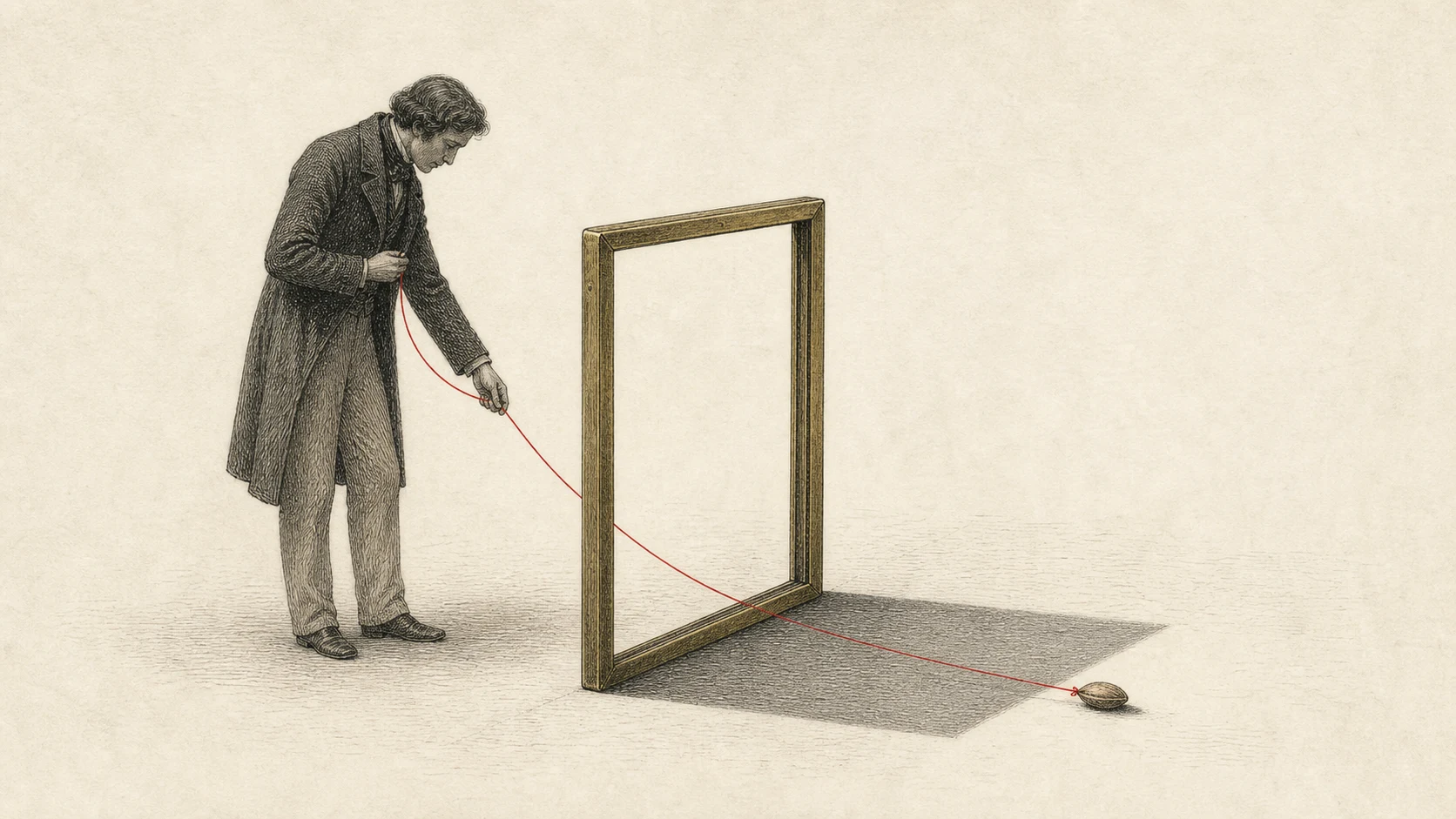
Why a dispute about power begins before a command or a vote—with the authority to name the problem, build the category, and decide whose bad news will be heard.
Victory changes the winner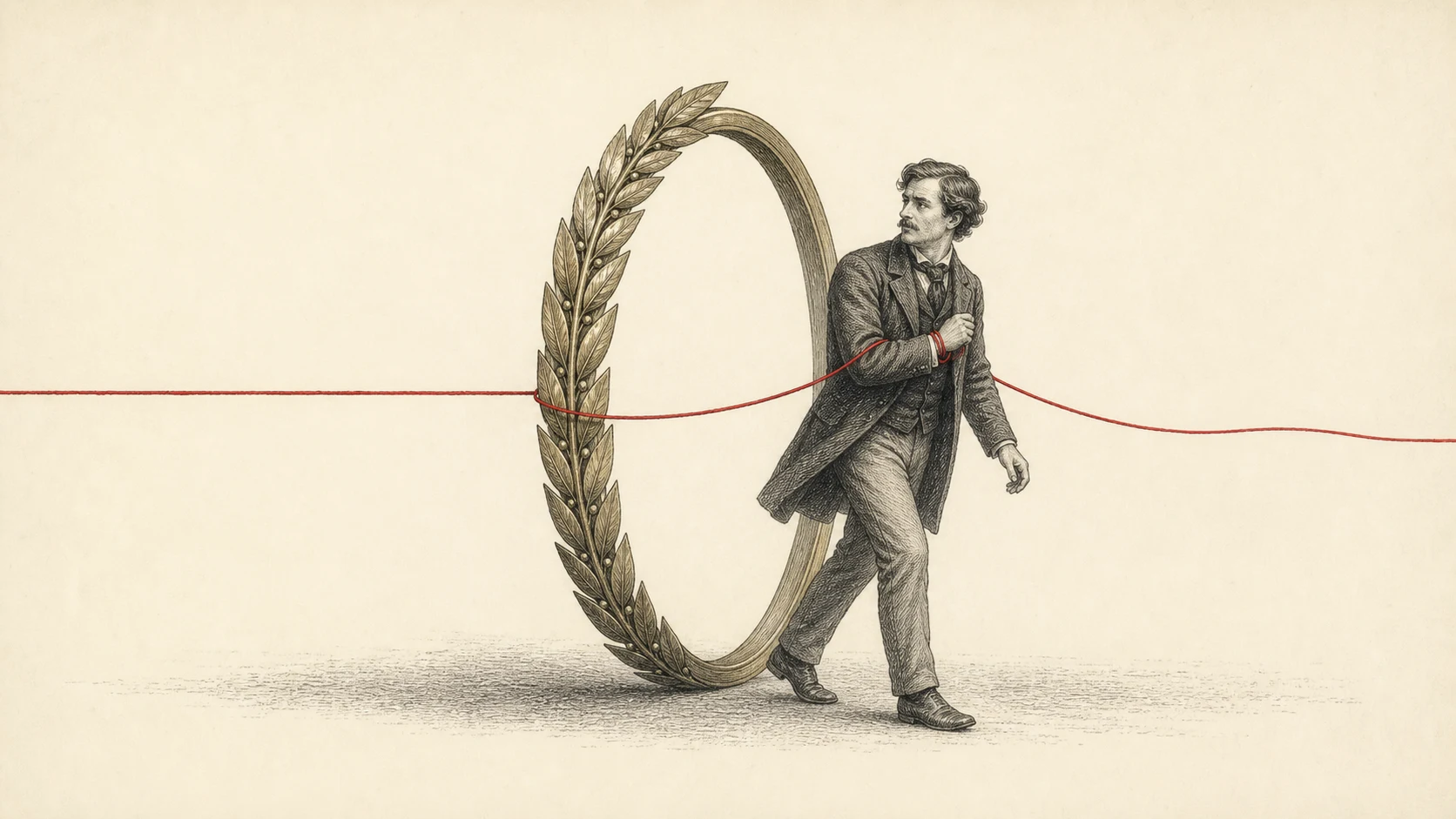
Success does more than give a person greater possibilities. It changes the people around them, the information that reaches them, and the explanation they construct about themselves. The central danger of victory therefore begins not when the result is lost, but when the result is taken as final proof that the winner was right.
Continue the thought
Works that test the thesis rather than repeat it
People jointly sustain definitions of situations and social roles; sincerity does not eliminate the stage, expectations, or impression management.
If This Is a ManPrimo LeviTestimony about the limit must preserve the particularity of people and mechanisms rather than turn horror into a beautiful parable about heroism.
Fooled by RandomnessNassim Nicholas TalebThe visible winner is a selected outcome, not automatic proof of mastery; the sample of losers is usually invisible.
The shoulders this chapter stands on
A source is not a seal of truth. Each entry says what it clarifies and where its lens needs to be limited.
David Hume
A Treatise of Human Nature
What it clarifies
Facts do not appoint goals by themselves: reasoning helps us choose means, but desire, feeling, and value provide direction.
What it does not prove
The role of feeling does not imply that every desire is reasonable, innocent, or equally worthy.
Leon Festinger
A Theory of Cognitive Dissonance
What it clarifies
When an action conflicts with a person's self-image, they often change the explanation in order to reduce inner tension.
What it does not prove
Not every change of mind is a defense of the ego; the theory does not let us infer a hidden motive without evidence.
Daniel Kahneman and Amos Tversky
Research on judgment and decision-making under uncertainty
What it clarifies
Predictable features of attention and framing systematically change judgments of probability, loss, and gain.
What it does not prove
A catalogue of biases does not make people hopelessly irrational and cannot replace analysis of the environments in which a simple heuristic may work well.
Richard Feynman
Cargo Cult Science
What it clarifies
The first requirement of inquiry is to actively report evidence that could show one's own explanation to be wrong.
What it does not prove
Personal honesty is necessary but insufficient without sound methods, independent scrutiny, and institutions that protect criticism.
Pierre Bourdieu
The Forms of Capital; the theory of fields and habitus
What it clarifies
A resource has force within a field: money, connections, education, manner of speech, and recognition operate by different rules and cannot be converted into one another without cost.
What it does not prove
The language of reproduction can underestimate unexpected action, creativity, and genuine changes in the rules.
Amartya Sen
Development as Freedom and the capability approach
What it clarifies
Freedom is not only a formal right or a resource, but the real opportunity to be and do what a person has reason to value.
What it does not prove
The approach deliberately provides no single list of goods; evaluating capabilities in practice remains contested and contextual.
Nassim Nicholas Taleb
Fooled by Randomness
What it clarifies
A visible winner does not prove the quality of the process: we must look for the role of luck, invisible losers, and risks capable of eliminating the next attempt.
What it does not prove
Taleb's own polemical style and vivid stories also require examination, not submission to a new authority.
Hannah Arendt
On Violence
What it clarifies
Power is not a leader's possession: it exists for as long as people remain capable of acting in concert.
What it does not prove
Real regimes often mix consent, dependence, coercion, and violence; a clean distinction does not describe the entire mixture.
Michel Foucault
Discipline and Punish; lectures on governmentality
What it clarifies
Power works not only through commands from above, but through norms, categories, measurements, institutions, and habitual ways of governing conduct.
What it does not prove
When power is seen everywhere, it becomes difficult to distinguish its degrees and sources or to recognize the possibility of responsible common action.
James C. Scott
Seeing Like a State
What it clarifies
To govern many people, a center simplifies reality into categories and measures; together with noise, it may erase the knowledge on which life depends.
What it does not prove
Criticism of simplification does not imply that coordination at scale, measurement, and standards are always harmful.
Immanuel Kant
Groundwork of the Metaphysics of Morals
What it clarifies
Another person must not be merely a means to our project: their capacity to choose places a limit on effective action.
What it does not prove
An abstract rule does not always resolve conflicting duties or show how to act within unequal relations of power.