Power determines not only decisions, but what can be seen, said, and changed
A command is the most visible form of power, but not the deepest. Before any command, someone has already decided who is present, which evidence counts as serious, what question enters the agenda, and how much it will cost a person to object or leave.
To understand power, it is not enough to ask who won an open dispute. We must see who shapes the options, the rules of visibility, the price of dissent, and people's capacity to act together.
If power is treated only as direct coercion, a choice without a safe alternative looks voluntary, silence is mistaken for consent, and a report convenient to the center passes for the whole of reality.
First, distinguish
Two concepts that are easy to mistake for one another
Coercion changes another person's behavior through a threat of harm or deprivation. Power in common is people's capacity to coordinate action toward a shared purpose they recognize. Employees may come in on Saturday from fear of dismissal, or because they decided together to prevent a dangerous accident. The outward action is similar; its source, right of objection, and durability are not.
Visibility is what a system can register, compare, and deliver to a decision-maker. Voice is the real ability of an affected person to challenge a category, rule, or decision and receive an answer. A person can be made visible as a row in a register without being allowed to explain an error. Data about a person is not the same as their participation in a decision.
Deep power selects the questions before the visible decision
Power appears not only in the ability to impose one's will, but in the ability to define permissible options, serious evidence, and the questions that will receive consideration at all.
Why this happens
An agenda allocates scarce attention; categories define the language of a problem; dependence raises the cost of dissent. If a participant cannot safely name an alternative, their formal right to speak changes little.
A board debates the size of a bonus but will not admit the question of why the bonus criteria are set unilaterally by the executive who benefits from them.
Do not confuse this with
Not every missing question is evidence of suppression: attention is limited and selection unavoidable. Hidden power is indicated by evidence of barriers, dependency, and an interest that is systematically excluded.
Where the idea stops working
An agenda cannot expand without limit. A legitimate procedure must explain its selection criteria, deadlines, and a route for resubmitting a question.
Question for the situationWho defined the list of permissible options, which interest was left without a language, and what would happen to someone who proposed changing the agenda itself?
The center governs reality through translation—and therefore depends on its translators
The longer the route from lived experience to a decision, the greater the power of forms, metrics, and intermediaries who determine what survives in a report and what disappears.
Why this happens
Scale requires a standard: different cases are compressed into common categories and numbers. This makes coordination possible but discards context. If a category can be corrected only by the center that controls it, the error becomes persistent.
The category “unemployed” helps allocate benefits, but may not distinguish a person caring for a bedridden relative who physically cannot accept a night shift. Without an appeal, the rule turns a difference into a violation.
Do not confuse this with
Do not confuse simplification with deception. Registers, standards, and metrics are necessary for large-scale medicine, rights, and budgets. The problem begins when a model hides what it loses and permits no correction from below.
Where the idea stops working
Local knowledge can also be biased and exclusionary. Proximity to a situation provides important experience, not automatic correctness.
Question for the situationThrough which categories and people does reality reach the decision, what is lost in each translation, and who has the right to correct a false record?
Obedience does not prove consent, and durability does not prove justice
Power deserves trust not because people submit to it, but because those affected can safely object, demand reasons, change the rule, and replace the holder of authority.
Why this happens
An accepted rule reduces the recurring cost of coercion, but the same habit may preserve an old injustice. Protected channels for voice, appeal, and exit turn bad news into information for correction instead of a personal act of heroism by the messenger.
Residents set the rules for their courtyard together, elect representatives, and maintain a simple exception procedure for emergency vehicles. Discussion without a right to change the rule would be only the appearance of participation.
Do not confuse this with
Do not confuse legality, popularity, and justice. A law may be accepted by a majority and still deny a minority equal protection.
Where the idea stops working
Voice and appeal slow decisions. In an emergency, authority may expand temporarily, but its duration, limits, and later review should be stated in advance.
Question for the situationCan a dependent person object without heroism, who must answer, and by what mechanism can the rule—or its holder—actually be changed?
Synthesis without reconciliation at any price
Power exists over people, among people, and within the rules of visibility
Arendt shows power arising from action in common and prevents us from mistaking fear for consent. Foucault reveals the norms, categories, and habits that govern behavior without a discrete command. Scott explains why power at scale needs simplified legibility; Hirschman shows how exit and voice change the quality of an institution. Together, these perspectives require us to examine the capacity to act in common, dependencies within the group, and the construction of the picture from which the group makes decisions.
A tension worth preservingWithout common action, people are powerless; without protected dissent, “common action” can become the name under which the powerful conceal subordination.
Long view
An essay that carries this idea through a complete argument

How can we remain faithful to reality when we encounter it only through imperfect observations, instruments, words, and institutions of knowledge?
Who Has the Right to Define Reality?
Why a dispute about power begins before a command or a vote—with the authority to name the problem, build the category, and decide whose bad news will be heard.
Victory changes the winner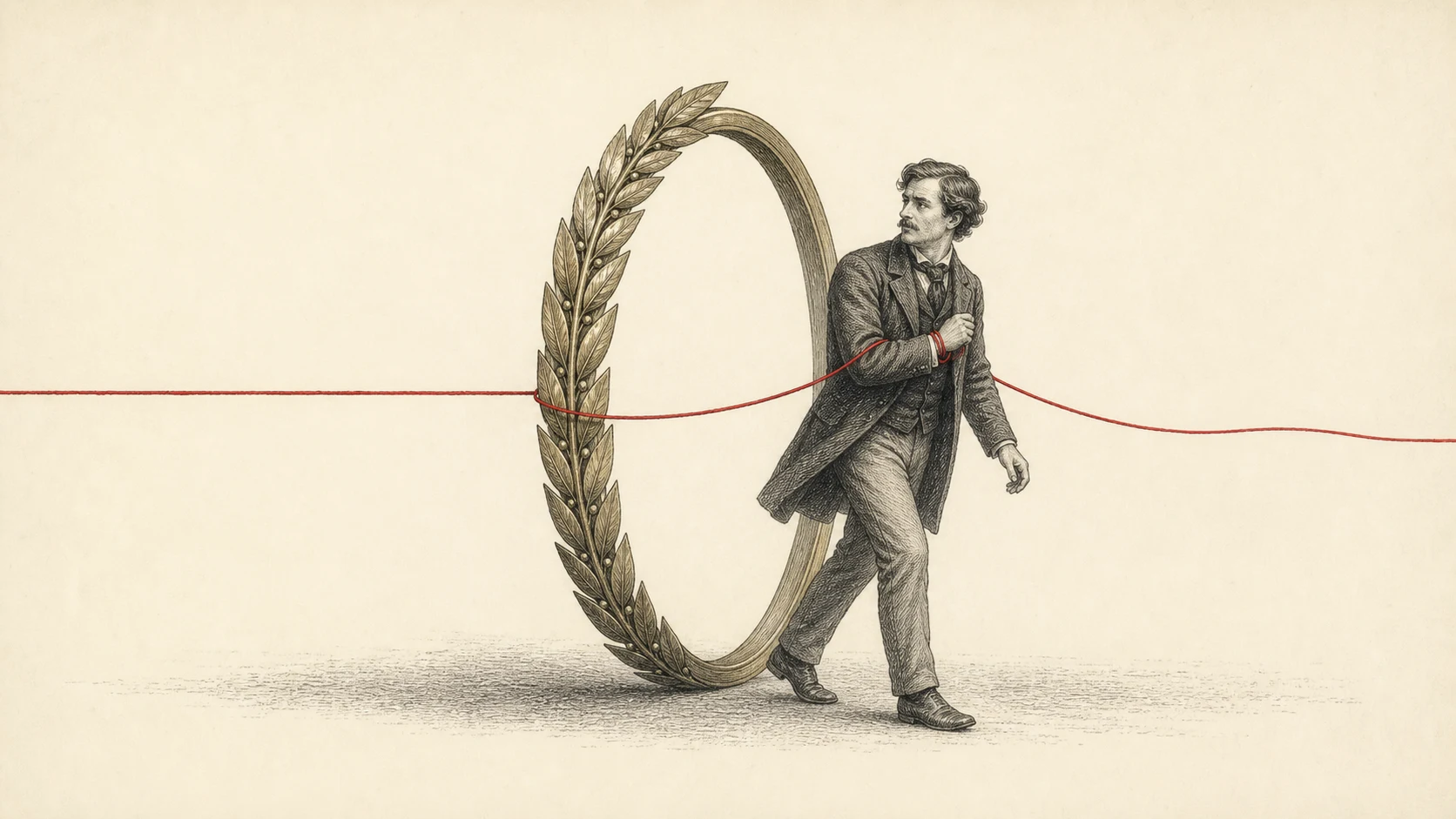
Success does more than give a person greater possibilities. It changes the people around them, the information that reaches them, and the explanation they construct about themselves. The central danger of victory therefore begins not when the result is lost, but when the result is taken as final proof that the winner was right.
Continue the thought
Works that test the thesis rather than repeat it
Recurring events are produced by a system’s stocks, flows, feedback loops, delays, rules, and goals.
Seeing Like a StateJames C. ScottTo govern a complex world, a central authority makes it legible—and may destroy local knowledge that does not fit the scheme.
The Human ConditionHannah ArendtAction begins among different people; its story always exceeds the intention of any single author.
The shoulders this chapter stands on
A source is not a seal of truth. Each entry says what it clarifies and where its lens needs to be limited.
Michel Foucault
Discipline and Punish; lectures on governmentality
What it clarifies
Power works not only through commands from above, but through norms, categories, measurements, institutions, and habitual ways of governing conduct.
What it does not prove
When power is seen everywhere, it becomes difficult to distinguish its degrees and sources or to recognize the possibility of responsible common action.
Albert O. Hirschman
Exit, Voice, and Loyalty
What it clarifies
When a system deteriorates, a person can leave, try to change it through voice, or remain out of loyalty; the availability of each response changes the others.
What it does not prove
Real people may be trapped without safe exit or voice; loyalty can be either constructive or exploited.
Hannah Arendt
On Violence
What it clarifies
Power is not a leader's possession: it exists for as long as people remain capable of acting in concert.
What it does not prove
Real regimes often mix consent, dependence, coercion, and violence; a clean distinction does not describe the entire mixture.
James C. Scott
Seeing Like a State
What it clarifies
To govern many people, a center simplifies reality into categories and measures; together with noise, it may erase the knowledge on which life depends.
What it does not prove
Criticism of simplification does not imply that coordination at scale, measurement, and standards are always harmful.
Amartya Sen
Development as Freedom and the capability approach
What it clarifies
Freedom is not only a formal right or a resource, but the real opportunity to be and do what a person has reason to value.
What it does not prove
The approach deliberately provides no single list of goods; evaluating capabilities in practice remains contested and contextual.
Elinor Ostrom
Governing the Commons
What it clarifies
Between privatization and command from above lie many durable arrangements that users of a common resource create and monitor themselves.
What it does not prove
Self-governance does not work automatically: boundaries, trust, observability, the right to change rules, and proportionate sanctions all matter.
Amy C. Edmondson
Psychological Safety and Learning Behavior in Work Teams
What it clarifies
A team learns when reporting an error, asking a question, and disagreeing do not create unacceptable interpersonal risk.
What it does not prove
Psychological safety does not mean an absence of standards, conflict, responsibility, or uncomfortable feedback.