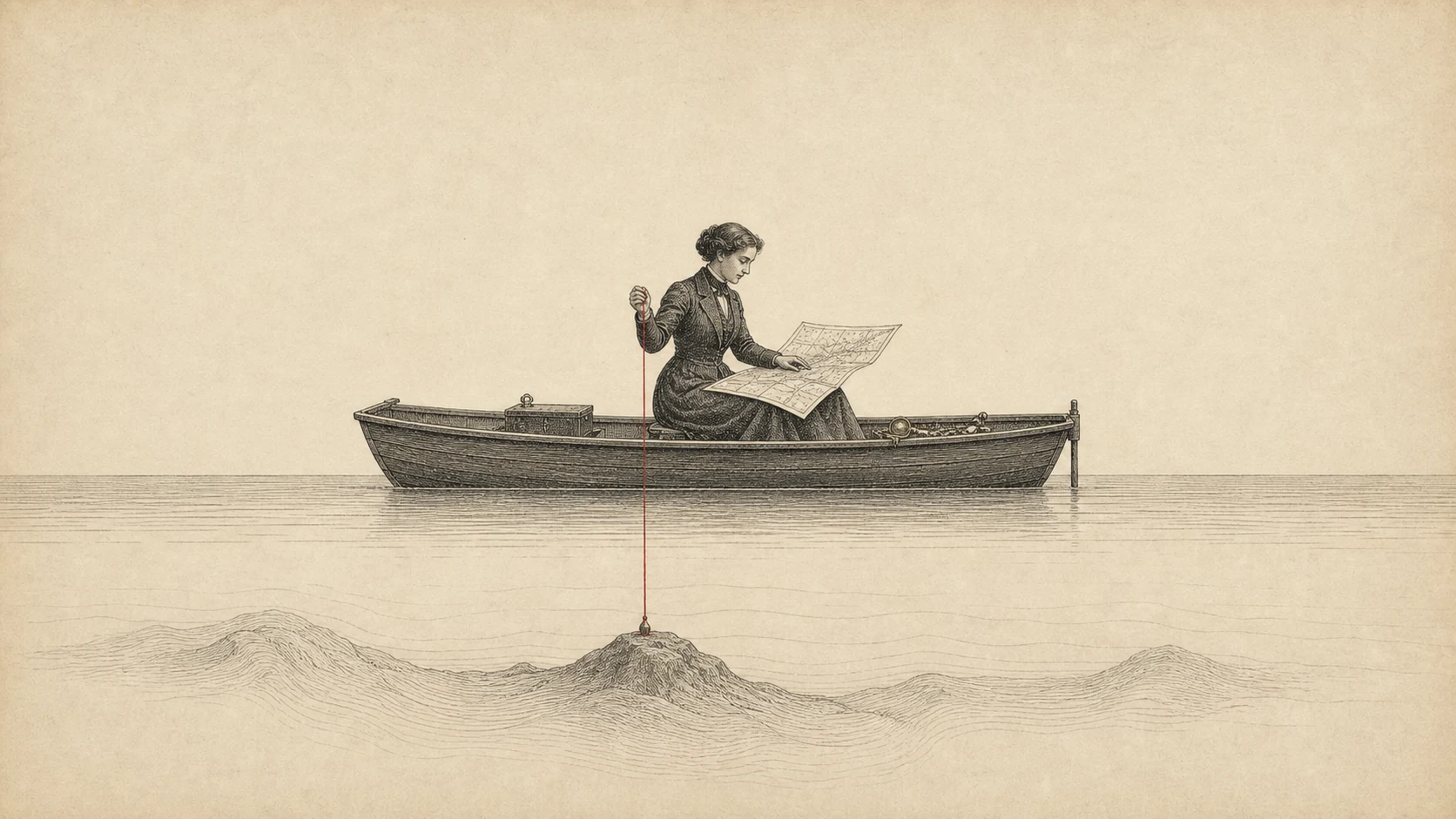
Reality leaves traces; explanation connects them into a story
We never receive an event whole. We see documents, numbers, memories, bodily symptoms, and consequences, then explain how they fit together. Intellectual honesty therefore begins with a simple order: first name the observable trace, then the inference drawn from it, then the evaluation, and only after that—the decision.
Reality does not supply a ready-made explanation, but it does constrain explanations: some stories withstand testing against traces and predictions; others do not.
When observation is confused with interpretation, the first convenient explanation becomes a “fact.” An organization then treats the wrong cause, a person argues with a label rather than an argument, and the unknown quietly fills with invention.
First, distinguish
Two concepts that are easy to mistake for one another
A trace is a change available to an observer: a record, measurement, testimony, symptom, or material consequence. A story is the connection we construct among traces to explain what happened and why. One trace may admit several stories. A fall in sales is an observable change; “people stopped liking the product” is only one hypothesis, alongside a price increase, a supply failure, or a change in accounting.
An inference is a claim about what probably follows from the observations. An evaluation is a judgment about whether it is good or bad, fair or unacceptable. Data may show that a rule shortened the queue. The data alone cannot decide whether the rule distributes waiting fairly among older people, working people, and the critically ill.
Record the trace first; then test what could have caused it
An observable change and its cause are not the same thing. A fact constrains an explanation, but rarely selects a single cause without further testing.
Why this happens
A sensor, a survey question, or a witness captures only part of an event. The mind then completes the links among the available traces using language, experience, and expectation. Comparing rival explanations against new traces lets us discard those that predict less well.
A student begins receiving poor grades. The teacher sees unfinished assignments and concludes, “lazy.” A conversation and a medical report reveal sleep disruption caused by illness. The grades were real; the first explanation was wrong.
Do not confuse this with
Do not confuse the dependence of observation on a chosen method of measurement with the belief that all stories are equally true. A blood test, event log, or independent witness can disprove a convenient interpretation.
Where the idea stops working
Sometimes a cause is so well established that further doubt is unreasonable. Demanding an endless search for alternatives can become a way of refusing to acknowledge proven harm.
Question for the situationWhich trace have I actually observed, which connection am I merely assuming, and what new observation would distinguish my explanation from a strong alternative?
No signal may mean there is no safe way to report one
A system of observation sees not everything that exists, but what it has a category, a sensor, access, and a safe reporting channel for.
Why this happens
An organization decides in advance what will count as data: which fields appear on a form, who is asked, and what happens to the person who speaks. Experience that does not fit a category—or is dangerous to report—vanishes from the report while continuing to shape reality.
A manager receives no complaints and assumes the team is content. Yet every complaint must pass through the supervisor who controls bonuses. An anonymous survey and rising turnover expose a problem the old channel could not register.
Do not confuse this with
Do not confuse “we did not record it” with “it did not happen.” But a suspected hidden problem should not be declared fact without a search for independent traces.
Where the idea stops working
It is impossible to measure everything. Signals must be selected; the task is to understand the cost of that selection and create additional channels where an error would be especially dangerous.
Question for the situationWhose experience cannot enter my picture—and what experience is missing because there is no category, access, or safety to speak?
An explanation teaches only if it can turn out to be wrong
A strong explanation names in advance the observation that would require it to be revised or replaced.
Why this happens
If every outcome can be reinterpreted after the fact as confirmation, an idea rules out no possible world and improves no prediction. A condition for revision forces us to separate an explanatory mechanism from words that merely protect a belief.
“The new campaign strengthens the brand” permits any excuse. A testable version says: “Within eight weeks, repeat purchases will rise from 18 to 23 percent; if they do not, we will seek another explanation.”
Do not confuse this with
Do not confuse a willingness to correct an empirical claim with having no convictions. A moral commitment not to humiliate a person need not be a prediction, but a claim about the consequences of a policy must answer to evidence.
Where the idea stops working
One awkward result does not always refute a complex model: the measurement or an auxiliary assumption may be wrong. So we should name in advance not only the criterion for revision, but also how the data will be checked.
Question for the situationWhat possible result would make me change this story, and where will I preserve my original wording before I learn the outcome?
Synthesis without reconciliation at any price
Not a view without a frame, but a frame capable of meeting the world's resistance
Kuhn helps us see that observation is organized by a community's concepts and practices. Popper and Feynman insist that this organization not become an impenetrable defense: an explanation must show where it risks being wrong, and the researcher must report evidence against their own account. A mature position promises neither “pure fact” nor surrender to “everyone has their own truth.” It preserves the path from trace to inference—and the path back, from a new trace to a corrected story.
A tension worth preservingWithout a frame we do not know what to look for; a frame that cannot be challenged begins deciding on reality's behalf.
Long view
An essay that carries this idea through a complete argument
Continue the thought
Works that test the thesis rather than repeat it
Forecasts improve when they are expressed as probabilities, broken into parts, updated with evidence, and scored for error.
12 Angry MenSidney LumetDoubt becomes a public force when a person does not claim to be infallible, but asks the group to examine the traces and conclusions again.
RashomonAkira KurosawaDifferent accounts of one event reveal the interests and self-images of their narrators, but do not prove that truth does not exist.
The shoulders this chapter stands on
A source is not a seal of truth. Each entry says what it clarifies and where its lens needs to be limited.
Thomas S. Kuhn
The Structure of Scientific Revolutions
What it clarifies
What counts as a normal problem, method, or piece of evidence is shaped by a community's historical practice, not by abstract logic alone.
What it does not prove
Paradigm change does not mean that truth is arbitrary or that every worldview is equivalent to a scientific theory.
Karl Popper
Conjectures and Refutations
What it clarifies
Knowledge grows not from infallibility, but from an arrangement that allows a strong hypothesis to encounter the possibility of error.
What it does not prove
Scientific practice is more complex than a single act of refutation; evidence depends on measurement, auxiliary assumptions, and a community.
Richard Feynman
Cargo Cult Science
What it clarifies
The first requirement of inquiry is to actively report evidence that could show one's own explanation to be wrong.
What it does not prove
Personal honesty is necessary but insufficient without sound methods, independent scrutiny, and institutions that protect criticism.
James C. Scott
Seeing Like a State
What it clarifies
To govern many people, a center simplifies reality into categories and measures; together with noise, it may erase the knowledge on which life depends.
What it does not prove
Criticism of simplification does not imply that coordination at scale, measurement, and standards are always harmful.
Michel Foucault
Discipline and Punish; lectures on governmentality
What it clarifies
Power works not only through commands from above, but through norms, categories, measurements, institutions, and habitual ways of governing conduct.
What it does not prove
When power is seen everywhere, it becomes difficult to distinguish its degrees and sources or to recognize the possibility of responsible common action.